
Mathematics has long offered us powerful ways to understand the universe, from the orbits of planets to the pulse of quantum fields. Symplectic geometry—a branch of mathematics that originated centuries ago with the study of celestial mechanics—was first developed to describe systems with interdependent elements like position and momentum. Today, it’s a cornerstone of physics, offering a structured way to describe everything from subatomic particles to the principles governing large-scale systems.
Yet, as I discovered recently, the underlying concepts of symplectic geometry can go beyond the realm of the physical sciences. In my own field of computer repair, I found that these mathematical principles could be adapted as a framework to streamline diagnostics, resource allocation, and strategic planning. This article is a journey through that realization, showing how an ancient branch of mathematics found a new role in the unlikely world of troubleshooting electronics.
My Journey: From Tiger Mom Expectations to Lifelong Curiosity
To understand why symplectic geometry caught my attention, you’ll need a bit of background on me. I’m Gabe Ng, a multicultural, multilingual problem-solver, fluent in Malay, Mandarin, Cantonese, English, Javanese, and Hokkien. Growing up in Malaysia, I was raised under the watchful eye of a “tiger mom,” who believed in relentless discipline and ambition. In my family, success was expected and achievement mandatory. As a child, the pressure was immense: failure was not an option. My family subscribed to a cultural mentality known as “Kia Su”—a Hokkien term meaning “afraid to lose”—which drove my upbringing and, in many ways, defined my approach to life. The fierce desire not to fall behind, to achieve at all costs, was ingrained from an early age.
One childhood memory stands out vividly: at age five, I was slapped hard across the face by my kindergarten teacher because I couldn’t recite my name, address, and phone number fast enough in both Malay and English. “Stupid child!” she yelled. My lip bled, and I was told to try again and again until I got it right. Such experiences instilled in me a tenacity and resilience that would shape my life. Growing up, I realized I had a drive to learn—an insatiable curiosity that led me to seek knowledge wherever I could find it.
In the small town of Kampar, Perak, I found refuge in an old colonial library, its shelves still stocked with books left by British settlers during the timber rush. Some of the books dated back to the early 1800s, and they transported me into worlds of ideas far beyond my small town. I’d spend hours reading these timeworn pages, surrounded by history and knowledge, as if the dusty tomes themselves were whispering secrets of the universe.
This love of learning stayed with me, and now, as the owner of Spacebar & Spacesicle—a computer repair business—I’ve brought this curiosity and resilience into everything I do. When I stumbled upon symplectic geometry, I knew I had found more than just a mathematical curiosity; I had found a way to make my work more precise, efficient, and insightful.
Discovery: Unveiling Symplectic Geometry as a Strategic Tool
My journey into symplectic geometry began, as so many modern explorations do, with a few late-night searches on Google and a bit of guidance from ChatGPT. The more I read, the more I realized that this branch of mathematics held a remarkable parallel to the work I do every day. At first, the formulations and symbols seemed abstract, distant from the hands-on work of computer repair. But slowly, as I explored deeper, I saw a structure and clarity that could be translated into my own world.
The core of symplectic geometry revolves around phase space—a concept in which every possible state of a system is represented by interdependent variables. In physical systems, these might be position and momentum. In my repair shop, they turned out to be time, diagnosis complexity, and resources. These variables, in symplectic terms, are linked by a “form” that ensures changes in one are balanced by changes in the others, maintaining stability within the system.
It struck me that computer repair, especially diagnostics, follows a similar principle. Each repair job demands a balance between time, complexity, and available resources, much like how a physical system balances its own variables. This insight opened up a new way of thinking about diagnostics as a dynamic, interdependent process—a concept I had been feeling but hadn’t yet been able to articulate.
Applying Symplectic Geometry to Computer Repair
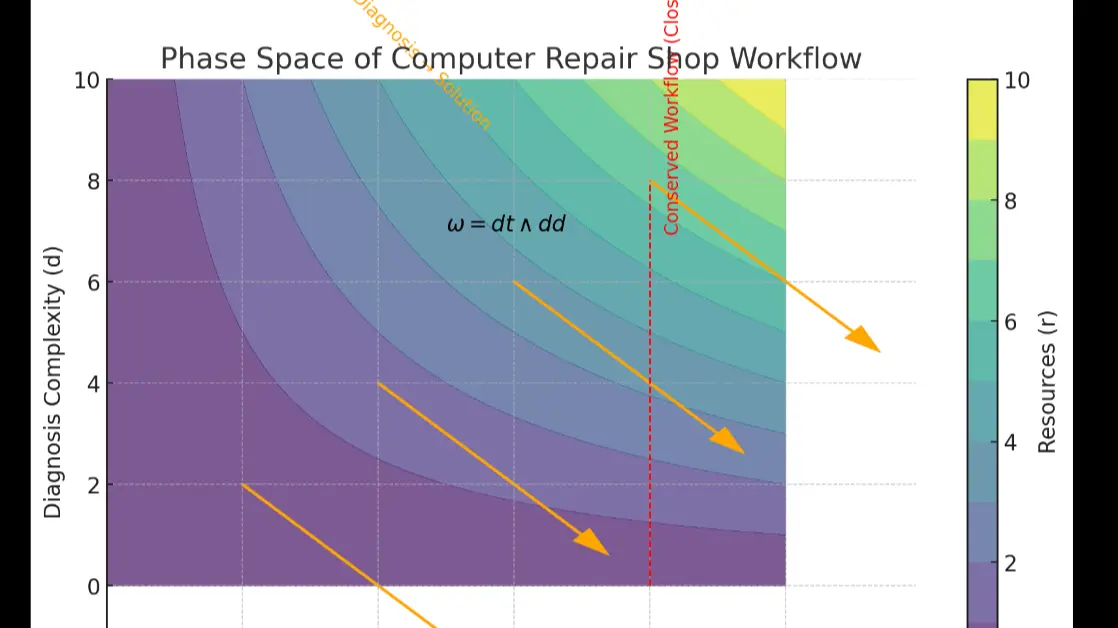
With this insight, I developed a model for my repair shop, a symplectic-inspired framework to streamline diagnostics and resource management. Below is a representation of how I translated symplectic principles into a practical tool for my business:
- Phase Space (Axes): The x-axis represents Time Allocated (t) for each repair, while the y-axis represents Diagnosis Complexity (d). Each point on this plane represents a specific state in the repair process, combining time and complexity for different types of jobs.
- Resource Allocation (Contour Levels): The background colors in the graph show Resource Requirements (r), increasing with both time and complexity. Diagnosing a simple software issue may require minimal resources, whereas a complex hardware repair demands more.
- Symplectic Form (ω = dt ∧ dd): This formula symbolizes the structured relationship between time and diagnosis complexity. By maintaining a balance between these two factors, I ensure that my resources are used efficiently. In practice, this helps me allocate the right amount of effort for each job without overspending time or materials.
- Direct Mapping (Orange Arrows): The arrows represent a direct mapping from diagnosis to solution, creating a structured pathway that avoids unnecessary steps. Each arrow indicates that each diagnosis maps directly to a specific solution, reducing redundancies in the repair process.
- Conserved Workflow (Red Dashed Line): The red dashed line represents a conserved workflow, much like a closed form in symplectic geometry, where no energy is lost. This conservation ensures a stable, consistent routine, even in the face of changing demands or unexpected issues.
The Power of Symplectic Geometry in Strategic Planning
Through symplectic geometry, I discovered a powerful new way to structure the operations in my shop. By treating diagnostic tasks as interdependent variables, I’m able to create a balanced system that minimizes waste and maximizes efficiency. This approach has not only streamlined my workflow but also provided a benchmark for evaluating new projects—allowing me to predict resource and time demands before taking on a job.
For anyone managing complex tasks, whether in computer repair, strategic planning, or beyond, symplectic geometry offers a structured framework to create balance. By mapping out the elements of a process and maintaining an interdependent relationship between them, you can design a resilient and efficient workflow that adapts to change while preserving stability.
Conclusion: Knowledge as the Ultimate Resource
It’s fascinating how an ancient branch of mathematics can transform something as everyday as computer repair. For me, symplectic geometry has been more than a tool; it’s been a way of thinking, a way of bringing order to chaos. This journey has been about more than just learning a new concept; it’s been about applying that concept to my world, using knowledge as a bridge between disciplines.
And so, if you’re curious about how these ideas could apply to your own work, let’s talk about it. Join me for a coffee or tea at Spacebar—maybe together, we’ll uncover more unexpected connections between abstract theories and the practical realities we face every day.
This page reproduces Gabe's authored LinkedIn article as a local, distraction-free reading edition. The narrative is rendered only as safe text—never as executable HTML.
Local images · Metadata removed · No LinkedIn scripts or backlinks